LeetCode Top Interview 150


21. Merge Two Sorted Lists
Easy
Merge two sorted linked lists and return it as a sorted list. The list should be made by splicing together the nodes of the first two lists.
Example 1:
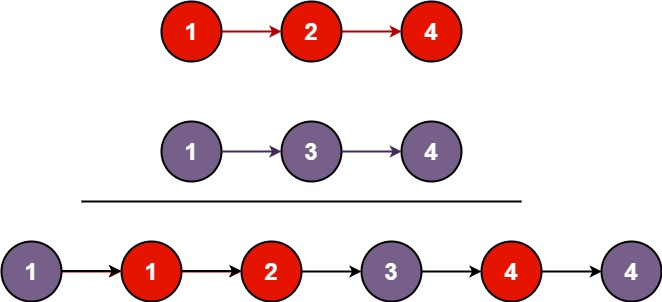
Input: l1 = [1,2,4], l2 = [1,3,4]
Output: [1,1,2,3,4,4]
Example 2:
Input: l1 = [], l2 = []
Output: []
Example 3:
Input: l1 = [], l2 = [0]
Output: [0]
Constraints:
- The number of nodes in both lists is in the range
[0, 50]. -100 <= Node.val <= 100- Both
l1andl2are sorted in non-decreasing order.
Here are the steps to solve the “Merge Two Sorted Lists” problem:
Approach:
- Initialize Dummy Node:
- Initialize a dummy node to simplify the code. The dummy node’s next pointer will point to the head of the merged list.
- Initialize Pointers:
- Initialize pointers
currandprevinitially pointing to the dummy node.
- Initialize pointers
- Merge Lists:
- Iterate until either
l1orl2becomesNone. In each iteration:- Compare the values of the current nodes in
l1andl2. - Connect the smaller node to the merged list.
- Move the corresponding pointer (
l1orl2) to its next node. - Move the
currpointer to the newly added node.
- Compare the values of the current nodes in
- Iterate until either
- Handle Remaining Nodes:
- After the loop, if there are remaining nodes in either
l1orl2, connect them to the merged list.
- After the loop, if there are remaining nodes in either
- Return Merged List:
- Return the next of the dummy node, which is the head of the merged list.
Python Code:
class ListNode:
    def __init__(self, val=0, next=None):
        self.val = val
        self.next = next

class Solution:
    def mergeTwoLists(self, l1: ListNode, l2: ListNode) -> ListNode:
        # Initialize dummy node
        dummy = ListNode()
        # Initialize pointers
        curr = dummy
        # Merge lists
        while l1 and l2:
            if l1.val < l2.val:
                curr.next = l1
                l1 = l1.next
            else:
                curr.next = l2
                l2 = l2.next
            curr = curr.next
        # Handle remaining nodes
        if l1:
            curr.next = l1
        elif l2:
            curr.next = l2
        # Return merged list
        return dummy.next

# Example Usage:
solution = Solution()

# Example 1:
l1_1 = ListNode(1, ListNode(2, ListNode(4)))
l2_1 = ListNode(1, ListNode(3, ListNode(4)))
result1 = solution.mergeTwoLists(l1_1, l2_1)  # Output: ListNode(1, ListNode(1, ListNode(2, ListNode(3, ListNode(4, ListNode(4))))))

# Example 2:
l1_2 = None
l2_2 = None
result2 = solution.mergeTwoLists(l1_2, l2_2)  # Output: None (empty list)

# Example 3:
l1_3 = None
l2_3 = ListNode(0)
result3 = solution.mergeTwoLists(l1_3, l2_3)  # Output: ListNode(0)
This code defines a ListNode class representing a node in the linked list and a Solution class with a method mergeTwoLists that takes two sorted linked lists (l1 and l2) as input and returns a new sorted linked list obtained by merging the nodes of l1 and l2. The example usage demonstrates how to create instances of the ListNode class and call the mergeTwoLists method with different inputs.